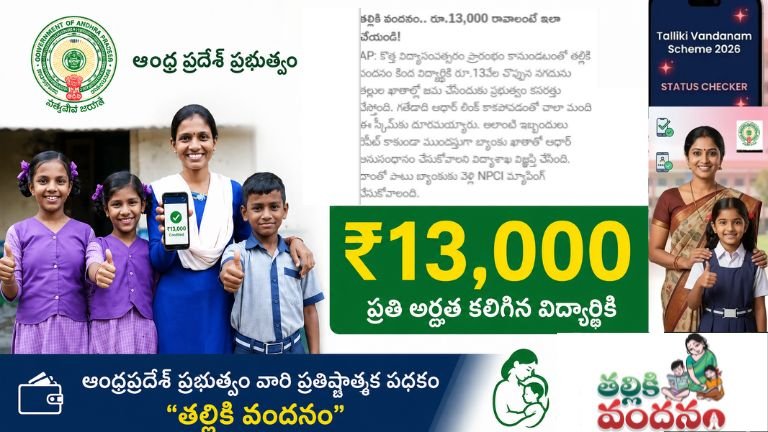
Thalliki Vandanam Scheme 2026: Mandatory Bank-Aadhaar Linking and Eligibility Guide
The Government of Andhra Pradesh is gearing up to disburse the financial aid under the Thalliki Vandanam Scheme for the 2026–2027 academic year. Aimed at curbing dropout rates and promoting education, this welfare initiative extends substantial financial assistance to eligible mothers or legal guardians who send their children to school.
To ensure a seamless, hassle-free Direct Benefit Transfer (DBT) directly into beneficiaries’ bank accounts, the State School Education Department has issued an urgent directive regarding mandatory bank account updates and linkage protocols.
Technical Overview of the Scheme
| Attribute | Scheme Specifications |
| Scheme Name | Thalliki Vandanam Scheme |
| Nodal State | Andhra Pradesh |
| Implemented By | Department of School Education |
| Total Scheme Value | ₹15,000 per eligible student per annum |
| Direct Bank Disbursement | ₹13,000 (Credited to the mother’s account) |
| School Maintenance Fund | ₹2,000 (Deducted at source for institutional hygiene & infrastructure) |
| Target Group | Students enrolled in Classes 1 to 12 (Intermediate) |
| Disbursement Mode | Direct Benefit Transfer (DBT) via NPCI Aadhaar Mapping |
| Official Check Portal | https://bm-sgsw.ap.gov.in/ |
Critical Action Required: Aadhaar & NPCI Mapping
During the previous academic cycle, a significant number of eligible mothers missed out on timely financial transfers due to unlinked Aadhaar records or inactive bank setups. To eliminate these technical bottlenecks, the education department has made it mandatory to fulfill two distinct banking compliances before the new academic session begins in June 2026:
1. Aadhaar-Bank Account Linkage
The mother’s or primary guardian’s unique Aadhaar number must be actively associated with their active core savings account.
2. NPCI E-Mapper Validation
The bank account must be mapped with the National Payments Corporation of India (NPCI). This enables Direct Benefit Transfer (DBT) processing by clearing public funds via the Central Government Aadhaar Payment Bridge (APB) system. Beneficiaries must physically visit their respective bank branches and submit an NPCI Mapping Consent Form if their accounts are not already enabled.
Comprehensive Eligibility Criteria
To quality for the Thalliki Vandanam disbursement for the 2026–2027 academic session, families must fulfill the following socio-economic and institutional mandates:
Institutional Demands
-
Enrolment: The child must be actively enrolled in a recognized government, private aided, private unaided school, or junior college within Andhra Pradesh (spanning Classes 1 to 12).
-
Attendance Threshold: The student must maintain a minimum of 75% classroom attendance throughout the academic year.
-
Course Exclusions: Students enrolled in professional or fee-reimbursed technical parallel courses like ITI, Polytechnic, or IIIT (RGUKT) are excluded from this scheme.
Household & Financial Parameters
-
Identification: The family must hold a valid, active State Rice Card (Ration Card).
-
Income Limits: Household monthly income must not exceed ₹10,000 for rural areas and ₹12,000 for urban municipalities.
-
Land Holdings: The family’s combined land must be less than 3 acres of wet agricultural land, or less than 10 acres of dry land (or less than 10 acres combined).
-
Utility Threshold: The average domestic electricity consumption over the preceding 12 months must be less than 300 units.
-
Asset Ownership: The household must not own any four-wheeled motorized vehicle (excluding commercial tractors, taxis, or auto-rickshaws).
-
Employment: No household member should be employed as a permanent government worker, public sector unit (PSU) employee, contractual state worker, or receive a formal government pension. Family members must also not be active income-tax payers.
Troubleshooting Discrepancies at the Sachivalayam
If your status shows “Ineligible” or “Pending Verification” on the portal, you must visit your local Grama or Ward Sachivalayam (Village/Ward Secretariat) immediately. Common issues include incorrect income data, outdated electricity consumption logs, or mismatching bank details.
Take your Rice Card, a copy of your electricity bill, your Aadhaar card, and your updated bank passbook to the Digital Assistant or Welfare Assistant. They can raise an official grievance ticket in the Navasakam system, allowing the School Education Department to re-verify your metrics and re-approve your application before the final cash distribution.
Understanding the School Maintenance Fund (SMF) Deduction
While the gross allocation per child under the Thalliki Vandanam Scheme is ₹15,000, the final amount credited to the mother’s bank account is exactly ₹13,000.
The remaining ₹2,000 is automatically deducted at the source by the government and diverted into the School Maintenance Fund (SMF). This dedicated fund is utilized directly by institutional committees to manage school maintenance, clean drinking water systems, washroom hygiene, structural repairs, and overall infrastructure upgrades under ongoing educational reforms. This structural deduction ensures that schools remain safe, clean, and well-equipped learning environments for the children.
Step-by-Step NPCI Mapping Verification
To independently confirm if your bank account is mapped with the National Payments Corporation of India (NPCI) for Aadhaar-based payments, follow these steps:
-
Step 1: Go to the official UIDAI MyAadhaar web portal.
-
Step 2: Log in using your 12-digit Aadhaar number and verify via the OTP sent to your registered mobile phone.
-
Step 3: Navigate to the “Bank Seeding Status” option under the services menu.
-
Step 4: The system will instantly display your active bank account name and your current Aadhaar Seeding Status.
Important: If the status displays “Active”, your bank account is perfectly ready to receive the ₹13,000 DBT transfer. If it says “Inactive” or “Not Seeded”, you must submit a physical Aadhaar seeding and NPCI mapping mandate form at your bank branch immediately to avoid transaction failures.
-
Apply.link
Step-by-Step Guide to Check Your Eligibility Status Online
The state has integrated the verification system into the Navasakam Beneficiary Management (NBM) ecosystem. Parents can verify if they are on the approved list for the 2026–2027 academic term by following this procedure:
-
Step 1: Visit the official state portal link: https://bm-sgsw.ap.gov.in/
-
Step 2: Locate and select the designated link for “Thalliki Vandanam Status Check”.
-
Step 3: Enter the unique 12-digit Aadhaar number belonging to the head of the household or the mother.
-
Step 4: Select the scheme name as “Thalliki Vandanam” and choose the current academic cycle year “2026–2027”.
-
Step 5: Click on the “Get Details” action button.
-
Step 6: Enter the secure one-time password (OTP) sent to the Aadhaar-registered mobile number and click “Verify”.
-
Step 7: Review the structural status summary displayed on your screen.
Important Indicator: If the parameter inside the Eligibility Calculator shows “Satisfied”, your application is cleared for automated disbursement. If any discrepancy or errors show up, immediately report them to your local Ward/Village Secretariat (Grama Sachivalayam) or your school administration to update your records before the final distribution date.