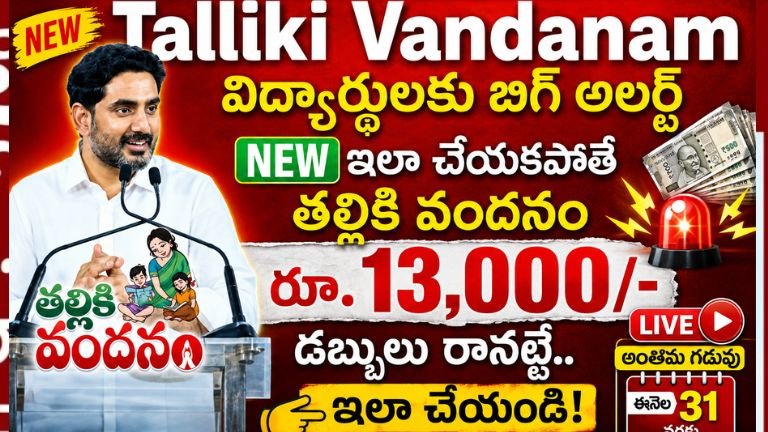
AP Talliki Vandanam Big Alert 2026: Complete Your Bank e-KYC Immediately to Claim ₹13,000
With the summer vacations concluding and state schools preparing to reopen their gates for the new academic calendar year 2026–27, the Government of Andhra Pradesh has issued an urgent administrative directive regarding the distribution of the prestigious Talliki Vandanam Scheme. The Department of School Education has mobilized its electronic infrastructure to transfer financial welfare payouts to an estimated 78 Lakh eligible mothers across the state.
However, an official backend evaluation highlighted a significant structural hurdle: thousands of otherwise fully eligible families face imminent transaction failure due to non-compliant banking channels. To prevent the automated system from rejecting your Direct Benefit Transfer (DBT) payment during the upcoming June disbursement loop, you must ensure that your designated bank account complies flawlessly with federal and state identity integration mandates.
1. The Core Update: Breaking Down the ₹15,000 Structure
The alliance government designed the Talliki Vandanam program to alleviate financial strain on low-income families sending their children to public and recognized private institutions spanning Class 1 through Intermediate education. While the headline value of the allocation stands at ₹15,000 per student, the structural execution breaks down into two distinct avenues:
-
Direct Mother’s Payout (₹13,000): This primary volume is transferred directly via automated electronic pathways to the verified savings account of the student’s mother to assist with personal scholastic requirements, transport, and reading resources.
-
Institutional Development Fund (₹2,000): The remaining slice is retained at the state level and funneled directly to individual school administrative committees. This money is explicitly earmarked to upgrade school structural integrity, optimize clean campus drinking water systems, and maintain bathroom hygiene infrastructure.
2. Why Technical Mismatches Blocked Past Payments
During the previous academic cycle, a substantial number of verified eligible mothers failed to receive their school welfare amounts despite having clear local inspection approvals. A retrospective analysis conducted by state digital governance wings mapped the breakdown down to a singular administrative shortfall: a total lack of physical Core Banking Aadhaar Seeding and NPCI (National Payments Corporation of India) synchronization.
When state clearing servers trigger a wave of automated welfare transfers, they do not read traditional bank account numbers or Indian Financial System Codes (IFSC). Instead, modern state systems execute transfers strictly using Aadhaar-based Mapping Channels. If a beneficiary’s identity number is not structurally bound within the central NPCI framework, the central database automated engine flags the destination route as completely unreachable, causing an unexpected transaction rejection.
3. Step-by-Step Guide: How to Securely Link Your Identity to Your Bank Account
If your database records indicate that your profile features an unlinked bank channel or a failed e-KYC status, you must proactively execute correction tasks immediately. The process cannot be handled entirely via third-party digital portals; a brief on-site banking visit remains necessary to activate the mapping profile.
What Happens Post-Submission?
Once the bank teller signs off on your verification paperwork, the profile shifts into an internal backend validation cycle. Understanding the operational timeline keeps you ahead of institutional delays:
System Propagation Window: Core banking processing centers typically require between 24 to 36 operational hours to update internal parameters. Once completed, your details are uploaded to the central database networks of the National Payments Corporation of India, turning your account into a permanently valid gateway for any upcoming state direct cash deposits.
4. Complete Mandatory Eligibility Criteria Review
To guarantee your name stays active on the final database distribution roster generated by the Grama/Ward Sachivalayam systems, confirm that your household continues to conform to the state’s welfare asset and income limits:
| Evaluation Metric Category | Mandatory Qualifying Threshold Boundary |
| Household Financial Earnings | Total monthly earnings must fall strictly under ₹10,000 for rural villages and remain under ₹12,000 for urban municipal centers. |
| PDS Card Status | The applicant family must possess an actively registered White Ration Card / Rice Card mapped to their regional fair price dealer. |
| Agricultural Property Limitations | Total land footprint cannot exceed 3 Acres of Wet Agricultural Land OR 10 Acres of Arid/Dry Land. |
| Residential Energy Consumption | The average monthly electricity draw over a moving 6-month window must sit below 300 Units. |
| Automotive Vehicle Restrictions | No individual listed on the household profile can own a personal 4-wheeled vehicle (Exemptions apply to commercial taxis, local auto-rickshaws, and tractors used for farming). |
| Employment/Tax Exclusions | The household must be completely free of active Government Workers, Regular Pensioners, or registered Income Tax filers. |
| Minimum School Attendance Record | The student must have their classroom attendance metric verified at 75% or higher by institutional administrators. |
Status Check Link
Click Here
“Frequently Asked Questions (FAQs)
How can I verify if my bank account already has active NPCI mapping?
You can verify this status online. Alternatively, you can visit the official Navasakam Beneficiary Management portal, navigate to the status search tool, enter your demographic identifiers, and check if the database layout labels your status as “Seeded” or “Active.”
Can the cash be sent to my child’s personal bank account?
No. The administrative protocol for the Talliki Vandanam scheme mandates that the cash amount must route explicitly to the biological mother’s or legal female guardian’s bank account. Student accounts are not authorized for this specific DBT wave.
What should I do if my name spelling differs between my bank book and my identity documents?
Name spelling variations are a common reason for automated transaction errors. If you detect a typo, visit your bank branch with your official identity card and submit a data correction request to ensure both records are perfectly identical before the June payment round commences.
Disclaimer: Ground procedures, portal domains, and departmental requirements are subject to structural adjustment by the School Education Department and state IT cells. Always consult your neighborhood Welfare Education Assistant (WEA) at your local Village/Ward Secretariat to verify final deadlines.